

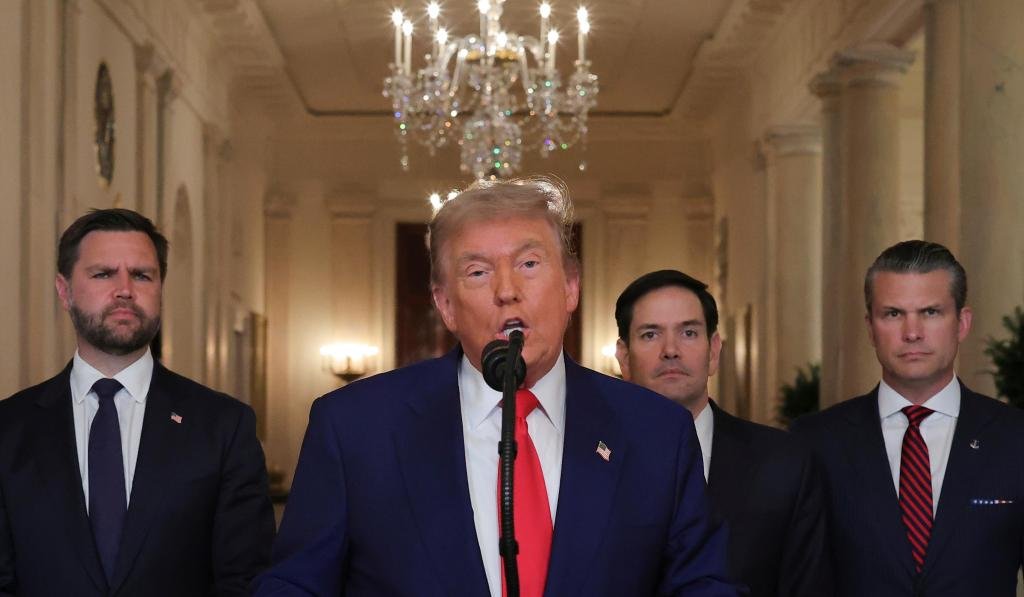

Historians will judge the massive U.S. strikes on Iran’s nuclear facilities by trying to answer two questions, which ultimately become inseparable. Was the intervention wise? And was it legitimate?
It’s far too early to assess the wisdom of Operation Midnight Hammer — that is, whether it will make the world safer. Stunning as its execution was, the mission’s objective was to end Iran’s ability to make nukes. But even though President Donald Trump keeps boasting that the attacks “obliterated” the Iranian targets, leaks of early intelligence from the Pentagon suggest that the bombing only set the nuclear program back by a few months.
If Tehran now hurries to make atomic bombs in secret — and if other countries in the region then build their own nukes for self-protection — the tactical triumph of Midnight Hammer will turn into a strategic disaster.
That ambiguity focuses attention on the strike’s legitimacy, in both domestic and international law. Trump implicitly acknowledged that tension with two contrasting statements he made within a few hours.
It may not be “be politically correct,” he Truthed just after the attack, but “why wouldn’t there be a Regime change???” This is the language of power in international affairs, unchecked by legitimacy. In a more official medium, he then dutifully declared that “I am providing this report as part of my efforts to keep the Congress fully informed, consistent with the War Powers Resolution (Public Law 93-148).”
His attack order was legal, he tried to argue, because it was not only “limited in scope and purpose” but also “taken to advance vital United States national interests.” This is the language of lawyers in pursuit of legitimacy.
The only international body that could have legitimated Trump’s (or Israel’s) campaign against Iran is the United Nations Security Council, but it did not do so. In fact, the UN Secretary General criticized Midnight Hammer as a “perilous turn,” and several members of the council, all too predictably including China and Russia, condemned the U.S. strikes.
Toothless Congress
The only domestic organ that could have legitimated the strike is Congress, but it wasn’t even given the chance. A number of senators and representatives — even including the odd Republican — are now calling Trump’s strikes unconstitutional.
Their reasoning is that the constitution’s Article I, Section 8, explicitly gives only Congress the power “to declare war.” Companion drafts censuring the military intervention are now sitting in the Senate and House.
As legislation, they’re moot, since Republican leaders won’t even let them come to the floor. But as texts, they function as open-ended indictments that Trump acted unlawfully.
In both international and domestic law, however, these indictments will never be adjudicated with clear verdicts. Jack Goldsmith is a Harvard law professor who led the Office of Legal Counsel (which advises the executive branch) at the time of the Iraq war, and who has studied these matters for much of his career. And yet he concludes that “the constitutional law of war powers is inscrutable.”
One problem is divining what the Founders intended. They certainly feared giving the president king-like powers to decide on matters of war and peace. But they also acknowledged (in Article II) that the president was “commander in chief” and had to be able to react fast if America was attacked.
In effect, they bequeathed an ambiguity to future generations.
That only became relevant once America became a superpower after World War II (the last time Congress officially declared war) and regularly had to intervene abroad. Presidents made a habit of acting unilaterally — that is, without congressional approval — in places from the Korean peninsula to Libya.
They still sought legitimacy, though. Sometimes they got it from the UN Security Council, as in both of these examples: Korea in 1950 and Libya in 2011. Or they got vague “authorizations for use of military force” from Congress, before going into Afghanistan in 2001, say, or Iraq in 2002. The UN too eventually acquiesced to the Afghanistan war, though never to the Iraq war.
Defining ‘war’
None of these cases addressed the underlying problems with legitimacy. What can a president do? And what even counts as “war,” as opposed to a strike or an assassination? In 1973, Congress tried but failed to clarify the matter when it passed a War Powers Resolution in response to Richard Nixon’s secret bombing of Cambodia (and over his veto).
Goldsmith considers that legislation a “Swiss cheese,” riddled with loopholes. The courts have also punted, rejecting cases on grounds such as “standing” (that is, who is allowed to sue) or considering them to be political rather than legal conundrums.
Which they are, of course, in both domestic and international contexts. What sets Midnight Hammer apart from most other U.S. campaigns, though, is that Trump didn’t even try to make a case for legitimacy before the fact, either to Congress or the Security Council.
He “has now taken a step far beyond” his predecessors’ legal stretches, argues Oona Hathaway at Yale Law School, “launching a war that lacks any plausible domestic or international legal authority.”
At worst, Midnight Hammer becomes another precedent for an increasingly lawless and anarchic world where, in a famous phrase, “the strong do what they can and the weak suffer what they must.” If in that world Iran becomes the 10th nation with nukes and others follow, future strikes — invariably in the name of “preempting” a threat from someone, somewhere — may even be nuclear.
At best, Trump now stops bombing, forces Israel to observe the ceasefire and resumes negotiations with Iran that will permanently remove the threat of its nuclearization. To improve on a previous deal with Iran to that effect, which Trump abandoned in 2018, the president should enshrine this new agreement in international law, by getting it through the UN Security Council and raising it to the status of an international treaty (or even integrating it into an existing one).
That pact will inspire confidence and make peace to the extent that all signatories and other affected parties (including Israel) still trust in international law and legitimacy. If Trump makes that trust his objective and works to achieve it, the whole world — including the Nobel Peace Prize committee in Oslo — should agree that Midnight Hammer ultimately proved to be wise.
Andreas Kluth is a Bloomberg Opinion columnist covering U.S. diplomacy, national security and geopolitics. ©2025 Bloomberg. Distributed by Tribune Content Agency.