


With so much controversy over the format for the next version of the College Football Playoff, let’s not forget this year’s event is largely unchanged.
The 12-team field will feature the five highest-ranked conference champions and seven at-large teams.
The top-four seeds will receive byes into the quarterfinals.
The No. 5-to-8 seeds will play at home in the opening round against the No. 9-to-12 seeds.
The format is clean, crisp and fairly popular — a stark contrast to some of the outlandish proposals for the 2026 iteration of the CFP.
In fact, there is only one change this year: Teams will be seeded according to their position in the final CFP rankings.
The highest-ranked conference champions are no longer guaranteed the top-four seeds.
Here at the Hotline, it’s called the Oregon Rule. The Ducks weren’t the sole reason for the adjustment. But their experience — and feedback — played a significant role in the change.
If you’ll recall, Oregon won the Big Ten and was the No. 1 seed in the inaugural 12-team playoff.
Needless to say, any other postseason event in the history of life on Earth would match the No. 1 team against the No. 8-9 winner in the quarterfinals.
But this being college football, the CFP didn’t use a straight seeding model. As a result, the Ducks drew a quarterfinal matchup against the sixth-ranked team that was assigned to the No. 8 seed.
What happened next? Yes, Ohio State ran the Ducks out of the Rose Bowl on its way to the national championship.
But it’s what happened after the blowout that intrigues us.
Oregon spoke up.
“They communicated to the commissioner, as did a lot of their fans,” CFP executive director Rich Clark told the Hotline last month at Big Ten football media days in Las Vegas.
“And the commissioner knew we needed to look at it.”
That commissioner would be Tony Petitti of the Big Ten, a prime mover on CFP matters.
What did the Ducks tell Petitti, specifically? Oregon athletic director Rob Mullens opted to tread carefully given the private nature of the discussions but said: “In hindsight, straight seeding would have been helpful.”
The Ducks also walked away from the CFP with a preference for avoiding the three-and-a-half week layoff they faced between the Big Ten championship game and the Rose Bowl, especially given that Ohio State had just 11 days off following their win over Tennessee in the opening round.
The Ducks were as rusty as the Buckeyes were sharp.
“Would we rather play a home game or get a bye? In our experience, the bye isn’t helpful,” Mullens said.
That piece probably won’t change, at least for the Big Ten and SEC champions. They are bound to be ranked in the top four and receive lengthy byes into the quarterfinals.
As was the case last December, the Ducks would be best served by finishing second or third in the Big Ten, dropping into the sweet spot for seeding (No. 5-to-8) and receiving a home game in the opening round.
Which is precisely how we see the situation unfolding.
Here are the Hotline’s projections for the 2025-26 College Football Playoff, with teams listed by seed.
1. Penn State (Big Ten champ): Everything sets up for the Nittany Lions, but can they avoid becoming the next Oregon, perhaps courtesy of Oregon, in the quarterfinals?
2. Clemson (ACC champ): Dabo Swinney’s best team since the Trevor Lawrence era has an easier path to the CFP than any title contender, thanks to a fair-to-middlin’ ACC
3. Texas (SEC champ): The Longhorns might be the rare team that needs three-and-a-half weeks off after they finish with the SEC gauntlet.
4. Texas Tech (Big 12 champ): Money can buy rings. Of course it can.
5. Alabama (SEC at-large): The source of so much debate during the 2024 CFP selection process will be a no-brainer at-large pick this year.
6. Notre Dame (Independent at-large): As long as the Irish finish 10-2 (or better), an at-large berth will be waiting. If they’re 9-3, it gets mighty dicey.
7. Ohio State (Big Ten at-large): A year after losing to Michigan and winning the national title, the Buckeyes would offer quite the twist if they beat the Wolverines and lost in the opening round.
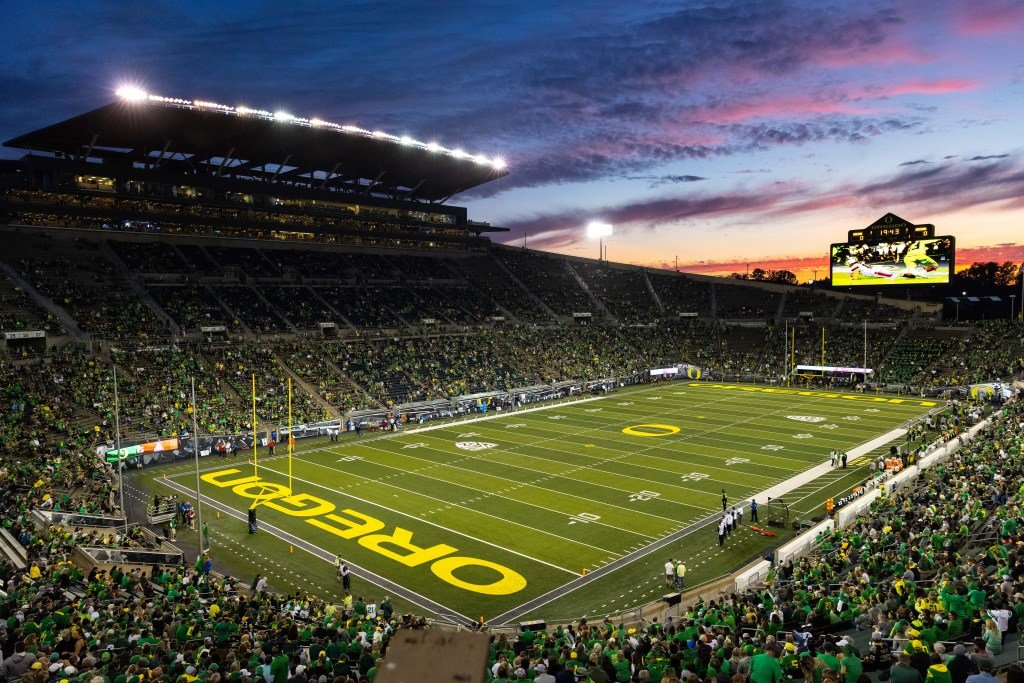
8. Oregon (Big Ten at-large): A playoff game in Autzen Stadium would be the biggest on-campus event in school history by an order of magnitude.
9. Florida (SEC at-large): Yes, every at-large team in our predictions is from the SEC or Big Ten. Our apologies for the cynical view, but they are running the show … or hadn’t you noticed.
10. Georgia (SEC at-large): The Bulldogs head to Columbus, site of Tennessee’s blowout loss last December, and produce a much different outcome.
11. Illinois (Big Ten at-large): This year’s version of Indiana but with a few quality wins — so, not really this year’s version of Indiana.
12. Boise State (Group of Five): What the Oregon game did for Boise State’s credibility last year, an October trip to Notre Dame can do this season.
*** Send suggestions, comments and tips (confidentiality guaranteed) to wilnerhotline@bayareanewsgroup.com or call 408-920-5716
*** Follow me on the social media platform X: @WilnerHotline