

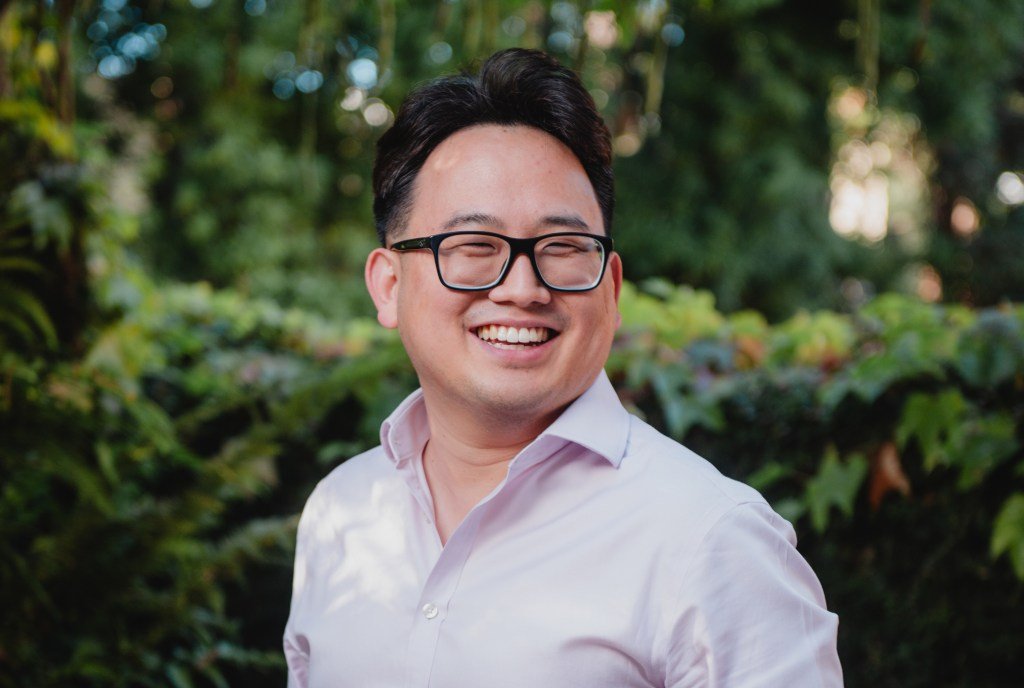
A federal judge has dismissed a years-long free-speech lawsuit by a sidelined Santa Clara County prosecutor against District Attorney Jeff Rosen, but the turmoil between the two will continue as the plaintiff is pursuing a second appeal — and a second political run to unseat his boss.

Judge Araceli Martínez-Olguín, of the Northern District of California, decided earlier this month to dismiss Daniel Chung’s First Amendment lawsuit alleging that he was the victim of retaliation for writing a February 2021 editorial submission. The opinion article, published in The Mercury News, argued that criminal-justice reforms had weakened consequences for serious offenders.
The heart of the First Amendment disagreement between Chung and Rosen was whether Chung was writing in his personal capacity or as a representative of the district attorney’s office. If he were presenting the opinion in his official capacity, he would have been subject to approval from his superiors.
Chung has always claimed he was writing as a private citizen; Rosen, through the County Counsel’s office, emphasized that the discipline of Chung was not rooted in the content of the op-ed but in him speaking for the office without authorization.
Chung was described as a deputy district attorney in the op-ed submission — part of standard attribution practice by The Mercury News — and the county highlighted an arbitrator’s finding that “it would be patently unreasonable” for a reader not to think Chung was speaking for the office, and so “even if (Chung’s) conduct was generally protected by the First Amendment, the county could nevertheless regulate through discipline that conduct.”
Martínez-Olguín wrote in her Sept. 17 ruling that the arbitrator’s finding meant “Chung is precluded from establishing that he was speaking as a private citizen in the Op-Ed, the speech is not constitutionally protected, and Chung’s First Amendment retaliation claim fails as a matter of law.”
Rosen’s office deferred comment on the ruling to the County Counsel’s office, which represented him in the litigation.
“We’re pleased with — yet another — District Court ruling in favor of the District Attorney,” County Counsel Tony LoPresti said in a statement. “We’re hopeful that this order puts an end to Mr. Chung’s repetitive attempts to advance his meritless litigation of these claims.”
Both Chung and his attorney, James McManis, objected to the judge’s conclusion and said they plan to petition for a review by the 9th U.S. Circuit Court of Appeals. The appellate court last year reversed Martínez-Olguín’s initial case dismissal, leading to the judge dismissing it again.
McManis contends that the evaluation of the First Amendment claim in arbitration was expressly stated to have no bearing on the separate litigation.
“It’s crazy what happened here,” McManis said in an interview. “At the beginning of the arbitration, the county went out of its way to say, we shouldn’t be talking about trying the civil-rights claim, that’s off limits.”
He added that Chung is “entitled to his day in court on the civil rights claim. We’re going back to the 9th Circuit for another appeal. This is a very strong case. It’s not over by a long shot.”
Over the past four years, Chung has been reassigned, benched and terminated by Rosen following a series of clashes, including the op-ed Chung wrote that the office deemed was out of turn. But only moderate discipline ended up sticking: Chung was reinstated in arbitration.
His taxpayer-funded salary remains on the payroll, though he is barred by Rosen from performing any work duties.
None of that, including the recent court ruling, has deterred Chung, and he insists on remaining with the office.
“It’s just part of the judicial process,” he said in an interview — during which he stressed he was speaking in his personal capacity. “Sometimes judges get it right, and sometimes they get it wrong. I have to be patient.”
Chung is also making a bid against Rosen’s heavily endorsed and well-supported run for a fifth term as district attorney in next year’s elections. In 2022, Chung surprisingly placed second in a three-man race, though his vote share was 24% to Rosen’s 55%.
When asked why he continues to remain employed at a place that literally won’t let him work and has sent him numerous signals to continue his career elsewhere, he points to his local roots — Chung is a Milpitas native who attended Harvard University, then Columbia Law School — and a bigger picture.
“It’s about sticking to my convictions,” he said. “It’s about vindicating myself, fighting for my job as hard as I fight for people. Part of it is that I’m fighting for the dignity of work and labor. I work for the people of the county: They pay me and expect me to work for my keep.”