


Editor’s Note: This article was written for Mosaic, an independent journalism training program for high school students who report and photograph stories under the guidance of professional journalists.
When Axel Tello discovered as a college sophomore a federally funded grant that would allow him to do paid lab research in any area of his choosing, he immediately applied.
Now a rising senior at UC Merced, Tello looked forward to gaining lab skills and experience, exploring different types of research and seeing real-life applications of what he learned in his classes – all without having to juggle another job to sustain himself.
Tello was eventually awarded an Undergraduate Research Training Initiative for Student Enhancement (U-RISE) grant which is distributed by the National Institutes of Health. The grant was everything he had hoped it would be.
But then in spring, things changed. Tello was supposed to have U-RISE funding until the end of his senior year, but instead the federal government terminated the grant a year early. Now Tello is left without funding for research next year.
His situation is far from unique. The federal government has abruptly cut grants to many researchers, including several at San Jose State University, leaving them with incomplete projects and struggling to find replacement funding.
Since February, numerous federal agencies have had billions of dollars for research projects slashed after the Trump administration sought to save money for billions in tax cuts and to eliminate support for diversity, equity and inclusion.
Executive directives cut more than $3 billion and canceled more than 2,000 awards at the NIH as of June 4, according to an analysis by the Association of American Medical Colleges. The National Science Foundation, meanwhile, was forced to cut more than 1,600 grants, according to its list of retracted awards.
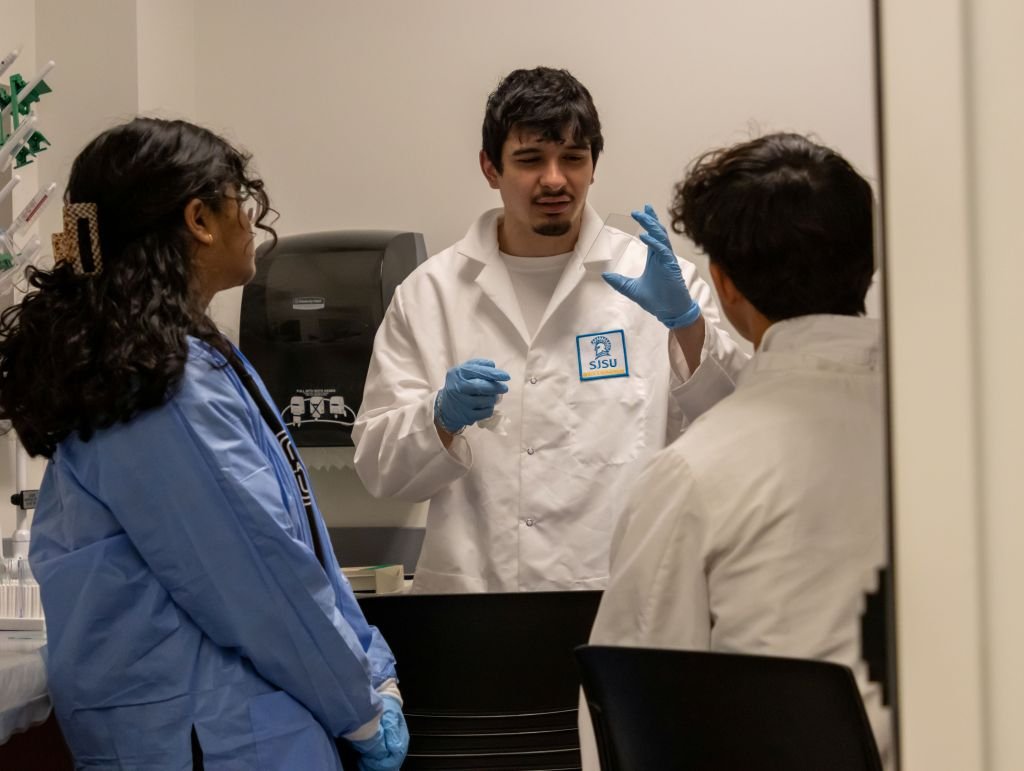
The U-RISE grant not only financially supported upperclassmen college students’ research but also taught them scientific communication skills and how to navigate graduate school applications.
These are opportunities that many of the students, who come from underrepresented backgrounds, wouldn’t have the resources for without the program, according to Cleber Ouverney, the U-RISE program director at SJSU.
“[For someone coming] from a community that doesn’t really have the ability to see what science looks like in their own community, U-RISE really gives students the hope that they can go farther and beyond overall,” Tello said.
Tello has a stipend from UC Merced that will support him over the summer, but if he wants to continue working in a lab in the fall, he’ll have to take on two jobs to make up for the lost funds.
For SJSU students on U-RISE, Ouverney said the university has provided some funding but not nearly as much as what the NIH grant awarded.
Professors, too, face funding difficulties.
Tammie Visintainer, associate professor of science education at SJSU, lost an NSF grant this year, two years before it was supposed to expire.
Visintainer had developed a 10-day summer training where teachers learned about the impact students’ backgrounds have on their experience with climate change. Teachers can still use the strategies Visintainer’s program implemented into their classrooms, but she can no longer offer the same amount of curriculum support.
Dustin Mulvaney, professor of environmental studies at SJSU, had two grants from the NSF and Environmental Protection Agency terminated. Mulvaney was researching a battery plant in Moss Landing in Monterey County.
Mulvaney said the search for new sources of funding has been difficult. State funding is usually awarded to projects with a specific focus, and foundations often cannot provide as much funding as federal agencies do, he said. He is planning to apply for a grant from San Jose State.
SJSU professor of science education Cassandra Paul also recently had a NSF grant cut. The money helped her develop a program to make undergraduate science, technology, engineering and math courses more accessible for underrepresented students.
“To think that the grant was canceled without any concern for the work that we were doing was heartbreaking,” Paul said. “It just feels like something’s ripped away from you. You put so much thought and care and intellectual energy into it to just be like, ‘well, that’s the end of it.’ It’s devastating.”
Adding to the frustration, many of the researchers said they have not heard much from the federal agencies that terminated their grants.
“Nobody knows what’s going on,” said Theresa Dinh, SJSU professor of biological sciences, who works with U-RISE students in her lab. “That’s the hardest part, the uncertainty and the lack of communication.”
Tello said grant cuts are doing more harm than good.
“Instead of propelling America forward with innovative technology, it’s just slowing it down,” he said.
Naomi Kotani is a member of the class of 2027 at Aragon High School in San Mateo.