

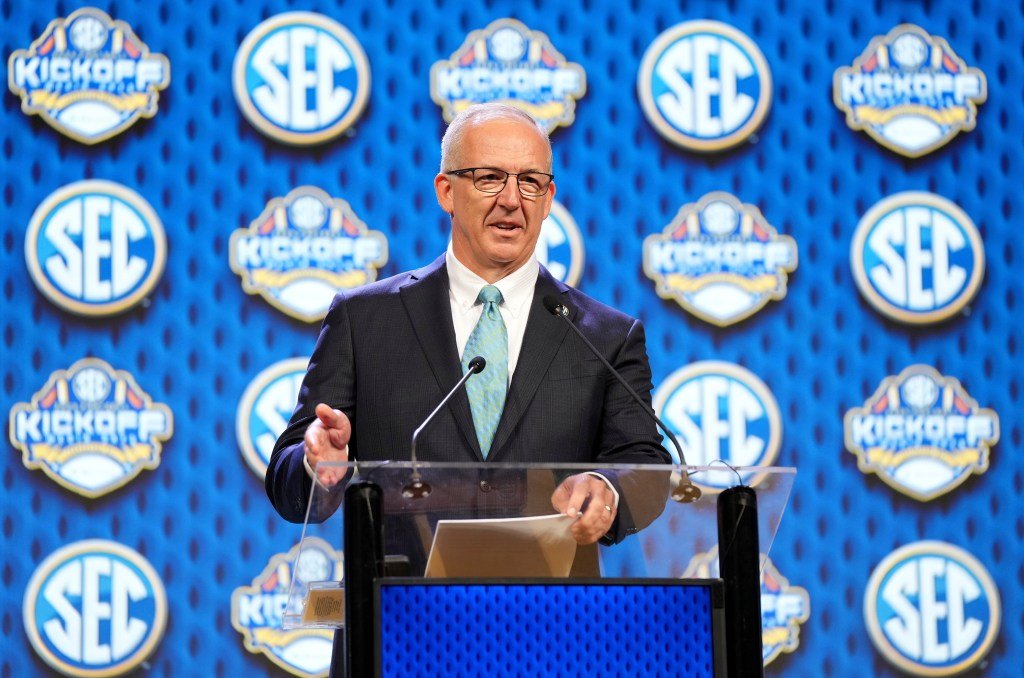

On the eve of the eve of the 2025 season, the SEC delivered thunderous news that will impact the sport for many seasons. After years of discussion and consideration, the university presidents voted to adopt a nine-game conference schedule beginning next fall.
The decision, announced Thursday, has sweeping ramifications for the regular season and the College Football Playoff.
Remember those stalled negotiations over the future CFP format?
The Big Ten supported a radical 16-team proposal full of automatic qualifiers while the SEC, ACC and Big 12 backed a model (dubbed 5+11) that leaned into at-large berths. The end result? Paralysis.
Well, the SEC’s schedule change could lead to a postseason breakthrough that benefits, among others, the Big 12.
Then again, the schedule change could have an adverse regular-season impact on, yes, the Big 12.
Before we plunge into the weeds, it’s worth noting that the SEC’s decision to add a ninth conference game came exactly one day after the CFP announced “enhancements to the tools that the selection committee uses to assess schedule strength and how teams perform against their schedule.”
Specifically, a new metric, record strength, has been added to the committee’s tool kit “that rewards teams defeating high-quality opponents while minimizing the penalty for losing to such a team.”
The changes were intended to mollify the SEC’s concerns that a ninth conference game wouldn’t undermine its chances with a decision-making body as subjective as the selection committee.
Now, the focus shifts to the Big Ten. To this point, commissioner Tony Petitti has refused to agree to the 5+11 model precisely because its subjective framework, with 11 at-large teams picked by the committee, favors leagues (SEC and ACC) that play only eight conference games.
In theory, the Big Ten will now relent and approve the 5+11 format preferred by Big 12 schools and commissioner Brett Yormark.
But the SEC’s schedule change will impact the regular season, as well.
As part of the decision, the SEC maintained its requirement that teams play at least one non-conference opponent from the Power Four leagues.
But a slew of SEC teams already have two non-conference dates with the ACC, Big Ten or Big 12 (or Notre Dame) scheduled in some future seasons. With the ninth league game now formalized, those teams would play 11 games against Power Four competition.
Consider Alabama, for instance.
The Crimson Tide is set to face West Virginia and Florida State in 2026, Ohio State and Oklahoma State in 2028 and Georgia Tech and Notre Dame in 2030.
With nine SEC games each year, the Tide’s schedule jumps from difficult to daunting.
“The implementation of a nine-game Southeastern Conference football schedule illustrates our league’s commitment to evolving with the changing landscape and creating even more high-profile matchups,” Alabama athletic director Greg Byrne wrote Thursday on the social media platform X. “This is a win for our program, student-athletes, fans and all of college football.”
And then Byrne added:
“With the addition of a ninth SEC game, we will evaluate our future non-conference schedules.”
The Crimson Tide isn’t alone.
Georgia, Florida, LSU, Missouri and South Carolina all have upcoming seasons in which they face two teams from the ACC, Big 12 and Big Ten, according to FBschedules.com, which tracks non-conference games.
From here, it appears numerous SEC home-and-home series with Big 12 schools could be in jeopardy.
Why? For starters, many of the SEC matchups against ACC foes are rivalry games (Georgia vs. Georgia Tech, Florida vs. Florida State, etc.) that are unlikely to be canceled.
Also, there are dates with Big Ten opponents (or Notre Dame) that have too much brand and media value to end up in the trash heap.
That leaves the Big 12, where, Arizona, Arizona State, Colorado, Oklahoma State, West Virginia, UCF, SMU and Kansas could see dates with SEC teams canceled.
Then again, the risk to future home-and-home series isn’t a surprise.
“If the SEC goes to nine,” ASU athletic director Graham Rossini told the Hotline in early July, “my hunch is they’ll want out of our games. We’re taking a wait-and-see approach.”
With clarity on their conference schedule, SEC schools could move quickly to make the necessary changes.
If the Big 12 loses games with the SEC, and the ticket-selling opportunities that come with them, the schools could turn to conferences like the Pac-12, Mountain West and American to backfill their schedules. (This is particularly true if the ACC also adds a ninth conference game, as expected.)
All in all, it’s another example of the sport’s elevated interconnectedness, with 100 schools at the whim of the 34 that make up the SEC and Big Ten.
Everyone else is left to hope for the best.
*** Send suggestions, comments and tips (confidentiality guaranteed) to wilnerhotline@bayareanewsgroup.com or call 408-920-5716
*** Follow me on the social media platform X: @WilnerHotline