

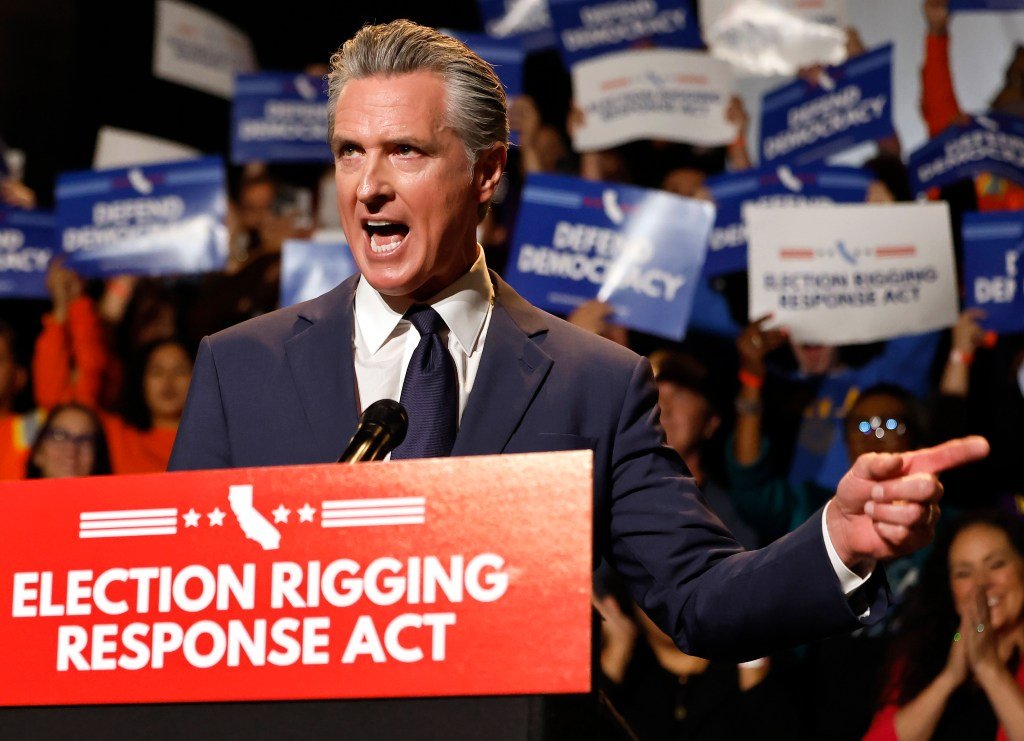

Gov. Gavin Newsom on Thursday officially revealed his controversial gerrymandering plan to grab five or six U.S. House of Representatives seats now held by California Republicans and deliver them to Democrats in a bid to counter a similar move by Republicans in Texas that President Donald Trump pushed.
Newsom touted his plan to create more Democrat-dominated districts shortly after about a dozen armed and masked U.S. Border Patrol agents in military-style fatigues appeared outside the Japanese American National Museum in Los Angeles where he was to speak, a move the governor called “pretty sick and pathetic.”
Maps detailing the redistricting would be released in the next few days, Newsom said. He said he believed he would have the two-thirds vote in both houses of the state legislature necessary to put the measure before voters in a Nov. 4 special election.
“These maps will completely neuter or neutralize what is happening in Texas,” Newsom said. Although similar bids to Texas’ gerrymandering are underway in other Republican dominated states, he said his initiative would only go ahead if Texas or another state carried out such plans.
“We’ve got to meet fire with fire,” Newsom said. “This is a break-the-glass moment for our democracy, for our nation.”
Former Gov. Arnold Schwarzenegger, who led the creation of California’s independent redistricting commission, has expressed opposition to Newsom’s plan.
The “Election Rigging Response Act” would short-circuit official redistricting, which happens every 10 years, led by an independent commission since 2010. If approved by voters, it would temporarily replace the current commission-drawn district maps from the 2020 census with maps approved by lawmakers, but not prevent the commission from drawing new maps after the 2030 census. The commission realignment would have otherwise taken place in 2030.
Rocklin Republican Rep. Kevin Kiley, whose seat would be at risk from redistricting, last week introduced legislation for a nationwide prohibition on early redistricting. In a Thursday news conference, Kiley said Californians voted to create the independent commission “to take the power out of the hands of politicians,” and Newsom’s plan represented “an attack on the voters of California.”
California Republican Party chairwoman Corrin Rankin on Thursday slammed Newsom’s plan as “a calculated power grab that dismantles the very safeguards voters put in place.”
Before Newsom’s press conference, his office posted video on social media of Border Patrol agents outside the press conference venue. Newsom’s office suggested “Trump’s private army” had showed up at the event to intimidate. The clip showed the Border Patrol’s Los Angeles chief Gregory Bovino saying the agents were there “making Los Angeles a safer place.”
The White House responded to questions from this news organization by sending links to X posts by White House spokesman Steven Cheung, who described Newsom as a “coward” who gave an “incoherent” speech.
Republicans are expected to face headwinds in next year’s mid-term elections. Current district maps for the House in California and Texas suggest Democrats are within three seats of reclaiming a U.S. House majority after the midterms. New York, New Jersey, and Illinois are also considering redrawing Congressional maps to combat the Texas plan.
Newsom’s plan appears headed into a costly battle. Schwarzenegger and prominent Republican donor Charles Munger, Jr., both billionaires, are credited with the initiatives that took the mapping of district boundaries away from state legislators in 2008 for the California Legislature and in 2010 for the U.S. Congress.
A spokesman told Politico that Schwarzenegger is opposed to what Texas is doing, and “to the idea that California would race to the bottom to do the same thing.”
Munger last month created an X account that has put up just a single post, saying, “Any attempt to undermine the nonpartisan California Redistricting Commission will be strongly opposed in the courts and at the ballot box.”
Both Munger and Schwarzenegger see the independent commission as part of their legacy, said Thad Kousser, a UC San Diego political science professor who studies state and national politics.
“My guess is that they do fight it but there will be plenty of money on the other side,” Kousser said.
Opponents of Newsom’s plan will likely take to the courts to stop it, said Dan Schnur, a lecturer at UC Berkeley and a former Republican political consultant.
“It will almost certainly be an immense court fight both about whether the initiative can be on the ballot, or if it passes, whether it can take effect.” Schnur said. Still, Newsom’s biggest challenge appears “political, not legal,” he said.
California voters like having an independent commission draw electoral boundaries for the House, a recent poll by UC Berkeley and Politico found. Almost two-thirds of respondents said they wanted to keep the panel, which is made up of five Republicans, five Democrats, and four people unaffiliated with either party.
Newsom’s office on Thursday dismissed the survey’s significance, saying the commission would stay in place.
Results of a second poll, released last week by Emerson College, showed just a third of voters supported the gerrymandering proposal.
“It’s considered conventional wisdom in politics that an initiative that starts out with less than 50% support is going to have an uphill path to passage,” Schnur said.
If Newsom can make the redistricting plan “entirely a referendum on Donald Trump, he has a good shot,” Kousser said. “I think Californians will be eager for that fight.”
The announcement capped days of social media mockery of Trump by Newsom — widely believed to be angling for the next presidency — with a series of posts on social media platform X mimicking the President’s posts using all-capital letters and over-the-top language.
“I, GAVIN CHRISTOPHER NEWSOM, AMERICA’S FAVORITE GOVERNOR (MANY SAY), WILL HOST THE GREATEST PRESS CONFERENCE OF ALL TIME,” a post Thursday said. “AFTER THAT – “THE MAPS” WILL SOON BE RELEASED. VERY MUCH ANTICIPATED. HISTORY MADE. THE GOP’S RIGGED GAME IS OVER!!!!”
Newsom’s newly combative and sometimes coarse social media posts — his press office has made fun of Trump’s medical condition that causes swollen ankles — and his response to the Texas gerrymandering plan, show a politician seeking to boost himself by adopting the tactics of Democrats’ primary adversary, experts said.
“Newsom is fighting fire with fire and making this part of his growing political brand,” Kousser said.
Schnur said Newsom’s move puts him “at the front of the national Democrats’ counter-offensive on redistricting,” and “it’s going to immensely help his profile, especially in Democratic circles, both at the state and national levels.”
Newsom on Thursday said he was following Trump’s example, and, “If you’ve got issues with what I’m putting out, you sure as hell should have concerns about what he’s putting out as President.”
However, GOP strategist Matt Shupe called Newsom’s social media posts “rage bait” by a governor who “hasn’t come to grips with his looming irrelevancy yet.”
Originally Published: